These are the types of questions we get every day from concerned travelers. At InsureMyTrip, the health and safety of travelers is our primary concern. We recognize the need to educate travelers about this topic and explain what travel insurance benefits may provide the maximum safeguard and protection available.
What is Ebola?
Ebola Virus Disease (EVD) is a rare but severe disease that can be carried in people and nonhuman primates. According to the Centers for Disease Control, the Ebola virus is spread through direct contact with:
Bodily fluids of a person who is sick, has died or has recovered from Ebola
Object contaminated with body fluids from a person sick with Ebola
Infected fruitbats or nonhuman primates
Someone who contracts Ebola will not show signs or symptoms right away, and the disease cannot spread until after an infected person has developed symptoms of the illness.
Symptoms for Ebola Virus Disease may appear anywhere from 2 to 21 days after contact. Many common illnesses can have the same symptoms as Ebola, and diagnosing the disease can be difficult.
How Can Travelers Protect Themselves?
In the United States, Ebola is a very rare disease. The only cases of Ebola within the U.S. were first contracted in other countries and later spread via human to human transmission.
Travelers visiting an affected area should avoid coming in contact with blood and bodily fluids. This includes any items that may have come in contact with an infected person’s bodily fluids such as clothing, bed linens, needles, or medical equipment. The CDC also suggests avoiding funeral or burial rituals that require the handling of the body.
Presently, there are no FDA approved vaccines to prevent the Ebola virus. An experimental vaccine called rVSV-ZEBOV is currently not commercially licensed but has so far been shown to be safe and protective against the Ebola Virus. Research for the vaccine is ongoing, and the CDC expects FDA licensure in 2019.
Trip Cancellation
A few travel insurance policies offer travelers the option to cancel a trip in the event the CDC issues a travel warning to their destination prior to departure. Trip cancellation coverage is available provided there were no CDC issued warnings for their destination before purchasing the policy.
This coverage protects pre-paid non-refundable expenses, including penalties, fees, and other costs that may be incurred due to cancellation. To be eligible for these benefits, the warning must be in effect during your dates of travel.
For assistance finding the right plan with this coverage, we strongly encourage you to call our licensed travel insurance agents at 1-800-487-4722.
What if the Airline Cancels Due to an Outbreak of Ebola or if the Flight has to be Quarantined?
Each airline may handle this process differently. Typically, the airline would reimburse a traveler or try to book them on an alternative flight if possible.
Comprehensive plans do offer coverage for quarantine, but each company writes the coverage differently, so be sure to call or check the certificate for the exact language.
What if I am Nervous about Going on the Trip and Want to Cancel?
There is an optional travel insurance benefit called Cancel for Any Reason that allows travelers to cancel a trip for any reason, including concern over the Ebola outbreak. The CFAR benefit allows travelers to cancel a trip for any reason and receive reimbursement of up to 75% of their insured trip cost.
To add CFAR coverage to your policy, you’ll need to match specific eligibility requirements – you can find them on InsureMyTrip.
How am I Covered if I Contract the Ebola Virus?
Your plan may cover you if you or someone traveling with you, as long as they are named on the policy, contracts Ebola while on the trip and requires medical attention.
Travel insurance can help provide coverage for unforeseen illnesses or injuries that occur while you are on your trip.
If the Ebola Virus is contracted while on your covered trip, your insurance provider would coordinate with the CDC to ensure you are receiving adequate treatment. However, each insurance company is handling this situation on a case by case basis.
Can I Get Evacuated Back Home if I Contract the Ebola Virus?
At this time, only the CDC has appropriate transportation means to evacuate someone who has contracted the Ebola Virus. Travel insurance may provide assistance with health care and emergency transportation cost.
If you are traveling to an area of the world that is experiencing an outbreak, be sure to look into travel medical coverage and medical evacuation coverage specifically.
We always recommend traveling safely and with as much knowledge as possible. Knowing the area of the world to which you are visiting and reviewing any CDC travel notices are a great place to start. Consider purchasing travel insurance that will cover you for any possibility that may fit your situation.
Is Ebola Covered Since It’s a Pandemic?
Typically, epidemics and pandemics are excluded under most policies. Each policy is different though, so please check the policy certificates, including the section listing exclusions accordingly.
Disclaimer: The information contained in this article serves as a general overview of benefits and should only be used for informational purposes. Refer to your individual certificate of insurance for specific coverages, exclusions and benefits. When in doubt, please contact one of our licensed agents for additional assistance.
New York City officials recently declared a public health emergency and ordered mandatory vaccinations to stop an outbreak of measles in parts of Brooklyn. According to the Center for Disease Control, in 2019 there have been confirmed cases of measles in 19 different states. This is the second-greatest number of cases reported in the United States since measles was eliminated in 2000.
Measles is a highly contagious virus. A simple cough or sneeze can spread the virus into the air, where it can remain suspended in the airspace for nearly two hours. Overall, the United States has a high vaccination rate against measles, and much of the population is protected by herd immunity. Most cases of measles in the U.S. result from an unvaccinated person traveling internationally. With measle outbreaks on the rise both domestically and abroad, there are steps travelers can take to protect themselves and those around them.
What is Measles?
Measles is an infectious virus that is highly contagious. The symptoms of measles generally appear one or two weeks after a person is infected. Measles typically begins with
High fever
Cough
Runny nose (coryza)
Red, watery eyes (conjunctivitis)
Two to three days after symptoms begin, tiny white spots may appear in the patient’s mouth. Fever and a rash of flat red spots break out typically after three to five days. (Source: CDC)
How Can Travelers Protect Themselves?
If travel plans bring you to an outbreak area and you or a traveling companion has not been vaccinated, there is an extreme risk of contracting measles. Up to 90% of people who come in contact with a contagious person will also become infected if they are not immune to the virus.
For travelers taking domestic trips, they should follow the CDC recommended vaccination schedule. The CDC recommends that children get two doses of the Measles-Mumps-Rubella (MMR) vaccine. The first dose starts at 12-15 months, and the second dose should be between ages 4-6. For adults who do not have evidence of immunity, the CDC recommends at least one dose of the MMR vaccine.
For travelers going abroad, the CDC suggests an expedited schedule. Babies should receive their first dose between 6-11 months and a second dose between 12-15 months. Infants who receive a dose before they are at least one year old should receive a third dose, and all vaccinations should be at least 28 days apart.
If you are traveling to the outbreak area with young children or unvaccinated companions, comparing travel insurance plans is a good idea. Most providers will have plans that cover all children traveling with you. Some, however, do not cover any child under the age of 6 months, so read the details of the plan you purchase carefully. Because children are most at risk for contracting the measles, you’ll want to insure them as well as you.
Cancel for Any Reason (CFAR)
Cancel for Any Reason (CFAR) provides greater flexibility than a standard travel insurance policy, enabling travelers to cancel a trip due to fear of an outbreak. The CFAR benefit allows travelers to cancel a trip for any reason and receive up to 75% of their trip cost returned. To add CFAR coverage to your policy, you’ll need to match certain eligibility requirements – you can find them on InsureMyTrip website.
Trip Cancellation
Trip cancellation coverage may apply if someone traveling has been diagnosed with measles after insurance has been purchased and cannot travel. With a doctor’s note, a traveler can file a claim with their provider to get a refund on the trip cost covered by the plan.
Medical Coverage
Your plan may also cover you if you or someone traveling with you contracts measles while on the trip and needs to be hospitalized or evacuated.
We always recommend traveling safely and with as much knowledge as possible. Know the area of the world to which you are visiting, review the CDC travel notices, and consider purchasing travel insurance that will cover you for any possibility that may fit your situation.
Disclaimer: The information contained in this article serves as a general overview of benefits and should only be used for informational purposes. Refer to your individual certificate of insurance for specific coverages, exclusions and benefits. When in doubt, please contact one of our licensed agents for additional assistance.
How Did Brexit Affect Travel Insurance for U.S. Travelers?
Brexit had minimal impact on how travel insurance works for U.S. citizens visiting the United Kingdom and European Union. U.S. travelers do not need to purchase separate insurance policies when visiting the UK and then the EU, or vice versa. A single comprehensive policy will generally cover all destinations included in a single trip, regardless of the UK’s EU membership status.
That said, Brexit did mark the end of automatic alignment between UK and EU travel policies. As a result, travelers should pay close attention to entry requirements and healthcare systems when planning multi-country trips across the UK and Europe.
When Did Brexit Take Effect?
The UK officially exited the European Union on January 31, 2020, followed by a transition period that ended on December 31, 2020. Since January 1, 2021, the UK has fully operated outside of EU structures, including those affecting border control and travel policy.
How Has Travel Insurance Changed Post-Brexit?
While coverage for Americans traveling to the UK or EU remains broadly consistent, there are some administrative differences post-Brexit. For example, medical systems in the UK and EU now operate independently, so policies that rely on local healthcare access may differ between regions.
What Should UK Citizens Consider When Buying Travel Insurance?
Post-Brexit, UK travelers may no longer have reciprocal access to EU healthcare systems. A travel medical insurance plan is recommended for anyone visiting the EU, particularly for trips longer than a few days or involving high-cost destinations.
Several UK-based insurers now offer Brexit-specific protections such as “travel disruption coverage” that addresses delays or cancellations resulting from new border procedures or travel policy shifts.
Do UK Citizens Need a Visa to Visit the EU?
No, UK citizens can still visit most EU countries for tourism or business without a visa for up to 90 days in any 180-day period. However, travel beyond that window may require a visa, depending on the country and purpose of visit.
What Has Changed with UK Passports?
Since 2021, UK passport rules have changed for EU travel. British passports must now have:
At least 6 months of validity remaining on the day of travel
A date of issue less than 10 years before your planned return
These rules apply to travel within the EU and also to associated countries such as Iceland, Switzerland, Liechtenstein, and Norway. They do not apply to travel to Ireland.
Travelers can use the UK government’s passport checker tool to ensure they meet these requirements.
Also note that the EU Pet Passport scheme no longer applies. UK residents traveling with pets to Europe must now follow new procedures. See the full guidance on gov.uk.
Disclaimer: The information provided in this article reflects the current post-Brexit travel environment. Travelers should always consult official government websites and review their policy documents carefully. For personalized assistance, contact one of our licensed travel insurance agents.
Once you’ve made the first deposit, it’s time to find travel insurance for your Disney trip. When starting your plan search, you’ll be asked to provide your total trip cost for your Disney vacation – but what does that include?
Most likely, the first time you tally your “total” trip cost for a trip to Disney, you won’t get it right. When purchasing a travel insurance plan, you’ll only be able to cover pre-paid, non-refundable costs. What does that mean? First we need to look at what Disney DOES provide for reimbursement options.
Disney Trip Cost, Refundable Items & Change Limitations
According to a Disney reservation representative, here are the details of reimbursement for a Disney Vacation Package:
You have up to 30 days prior to arrival at Disney to cancel your trip.
Modifications to your trip (change hotel, change dates or meal plan) within 30 days of departure are subject to a $50 change fee.
Canceling your trip within the 30-day window of departure is subject to a $200 penalty.
If you cancel on or after your day of arrival, you forfeit the full amount of your trip.
What does this all mean? GET A SEPARATE TRAVEL INSURANCE PLAN! The cost of a trip to Disney is getting more and more expensive. (Seriously, they have increased their ticket prices again in 2019.) Why risk the possibility of losing the money you invested in your family vacation?
This information also sheds light on what may be considered “insurable” and what isn’t. Below we have listed the travel expenses you’ll most likely have when booking a trip to Disney. With each expense, we clarify how they fit may into your “pre-paid, non-refundable” trip cost to mark when quoting a travel insurance plan.
Disney Package Cost Calculation Should Include Total Amount
As noted above, there comes a point in time when you will no longer be able to get a refund for your Disney Vacation Package. Because of this, you should include the total amount when insuring your Disney vacation. It’s important to note that if you cancel your trip and are provided a refund with fees, your travel insurance may only cover the amount of the incurred fees. You are not able to receive reimbursement for refundable costs. However, if you cancel within the non-refundable period, you’ll be glad you have insured the total cost.
Flight Cost
Several travelers fly on airlines that provide refunds for ticket changes and no cancellation fees. However, if you are traveling on an airline with a non-refundable ticket or does include cancellation fees, you will want to add the flight costs to your travel insurance plan. If you are unsure which type of ticket you purchased, call your airline or review your reservation.
Rental Car Cost
Much like the airline industry, rental car companies have different policies for cancellation. If your rental car company does not provide refunds for pre-paid rentals or has a fee for canceling, you should include the expense in your travel insurance plan. If you aren’t paying until you pick up the car or the rental is refundable with no fees, you shouldn’t add it to your plan.
Additional Entertainment
Orlando is a fun place with so much more to offer than Disney World. Likewise, Anaheim can offer a lot to a family vacation off of the Disney property. Planning to attend any amusement parks, baseball games, or shows on your vacation? If any costs for activities are not included in your Disney Vacation Package, you should double-check whether you would receive a refund. If they are non-refundable and you have an invoice dated prior to your departure, you can add these costs to your total trip cost when buying a travel insurance plan for your Disney trip.
What If You Add to Your Disney Trip Cost After Purchasing a Plan?
After you purchase travel insurance, you may decide to upgrade your room or extend your vacation. Don’t worry! You can increase your total trip cost after you’ve purchased a plan. Sometimes it may increase the premium on the plan – but it can be handled expertly by one of our licensed travel insurance representatives!
Disclaimer: The information contained in this article serves as a general overview of benefits and should only be used for informational purposes. Refer to your individual certificate of insurance for specific coverages, exclusions and benefits. When in doubt, please contact one of our licensed agents for additional assistance.
Disclaimer: This article contains affiliate links. If you make a purchase through these links, we may earn a small commission at no extra cost to you.
Packing for a flight can be a challenge due to diminishing room in overhead bins and space in general. We’ve put together a list of tips for not only packing for a flight but also making sure your carry-ons are compact and lightweight. After all, who wants to pay for additional baggage fees when it’s avoidable? Learn how to pack efficiently while saving your precious travel budget.
Airlines have changed since their inception. Everything evolves, but the industry has gone from being a luxurious mode of transportation to flying Greyhound buses filled with sweatpants and headphones. I’m glad smoking was banned, but the ham sandwich dinner option (when there actually is an option) is far from the prime rib dinners of the late 60s. Sure, some airlines offer lavish quarters with lay-down seating, televisions and showers. Yet here we are, spending most of of the time in the middle seat watching a B movie through spotty Wi-Fi as the guy in the window seat asks to exit for the bathroom for the third time in 45 minutes. But then again, the flight only cost $212.00.
Because the cost is so low, we tend to suck it up. That’s the way we’ve convinced ourselves to be okay with minimal leg room and peanuts alongside four hours of confinement. But the minute airlines start dipping into our wallets unnecessarily, we become resentful. It’s difficult to justify paying for that spotty Wi-Fi, and travelers always prefer their bags fly free.
How can you charge a person for flying with stuff? Who could head across the country for two weeks, but not bring anything with them?
So how can airline passengers beat the system? How can travelers give a big “not my bag” gesture to the airlines? Pack smart, pack light, and leverage carry-ons. If you’re like most travelers, you have have no intentions of handing over more money to the airline once you’ve purchased your tickets.
How to Pack for a Flight
1. Buy a Small, Lightweight Carry-On Bag
Treat yourself. Get a fun color, something you’ll love, because this will be your only bag. Make sure the one you select meets TSA guidelines and fits easily in the overhead bin. Samsonite offers high quality luggage for all types of travelers.
2. Don’t Pack Extras
You don’t need that extra jacket; you have a jacket on. Yes, it will be warm enough. You still don’t think so? Then wear the other jacket and leave the lightweight one at home. No, I’m sorry, but if you’re looking to maximize space in your carry-on, you probably can’t bring both.
3. Pack for Half Your Trip
If you’re going for 7 days, pack for 4. Laundry service is typically still cheaper than forking over more money to the airlines.
4. Rubber Bands
You can roll clothes even tighter when you secure them in rubber bands or hair elastics to save even more space in your luggage. But if you plan on rolling your clothing, you should probably master that hotel iron too. For a more organized option, packing cubes can help make the most of your luggage space.
5. Skip the Toiletries
If you’re staying somewhere that doesn’t offer you shampoo, conditioner, soap and face wash, you should step up your travel game. Leave that room in the bag for something else.
6. No Books
Seriously, take a nap or watch a show on the spotty Wi-Fi. Times have changed so now you can easily download a book to your Kindle or tablet. This saves valuable space that bulky books would otherwise monopolize.
7. One Pair of Shoes
You’ll already be wearing one pair of shoes when boarding your flight. How many feet do you have? I know, it seems like a challenge. It’s up to you. For many travelers, it’s not the $35 fee they’re looking to avoid but the principle of being presented low-fares and then hit with non-essential add-ons.
You Decide
Our guide to packing for a flight may just be what your travel game needs. However, if you insist on bringing more than a carry-on on your trip, you may want to consider insuring your baggage to protect against delay, damage, or loss. Whatever you decide, see you in the air! We’ll be in the middle seat enjoying the free pretzel sticks until they take those away too.
Golden Getaways: Exploring Senior-Friendly Destinations
The golden years are some of the best to travel in, to be able to explore new places and discover new cultures. Whilst traveling is enjoyable at any age, not worrying about the stress of work and being able to travel with your grandchildren make some of the best vacations. Whether that be a trip of a lifetime touring the temples of Thailand or relaxing on the beaches of Greece.
Traveling can come with its own challenges, and at InsureMyTrip we’ve created an index that ranks 50 cities worldwide, considering what is important for senior travelers. An overall score for each city allows you to see what we believe is the best city for senior travelers. You can also see how cities rank for each category.
Rank
City / Country
Country
Overall
1
Istanbul,Turkey
Turkey
8.09
2
Athens,Greece
Greece
8.03
3
Rome,Italy
Italy
7.99
4
Bangkok,Thailand
Thailand
7.92
=5
Tallinn,Estonia
Estonia
7.68
=5
Vilnius,Lithuania
Lithuania
7.68
=7
Prague,Czech Republic
Czech Republic
7.61
=7
Riga,Latvia
Latvia
7.61
9
Berlin,Germany
Germany
7.53
10
Helsinki,Finland
Finland
7.50
11
Vienna,Austria
Austria
7.44
=12
Abu Dhabi,United Arab Emirates
United Arab Emirates
7.42
=12
Lisbon,Portugal
Portugal
7.42
=12
Ljubljana,Slovenia
Slovenia
7.42
=15
Madrid,Spain
Spain
7.41
=15
Tirana,Albania
Albania
7.41
17
Copenhagen,Denmark
Denmark
7.34
18
Zagreb,Croatia
Croatia
7.31
19
Shanghai,China
China
7.30
20
London,United Kingdom
United Kingdom
7.29
=21
Hong Kong,Hong Kong *
Hong Kong *
7.27
=21
Oslo,Norway
Norway
7.27
23
Stockholm,Sweden
Sweden
7.23
24
Budapest,Hungary
Hungary
7.21
25
Belgrade,Serbia
Serbia
7.20
26
Melbourne,Australia
Australia
7.19
=27
Warsaw,Poland
Poland
7.18
=27
Zurich,Switzerland
Switzerland
7.18
29
Doha,Qatar
Qatar
7.15
30
Singapore,Singapore
Singapore
7.14
31
Manama,Bahrain
Bahrain
7.10
32
Amsterdam,Netherlands
Netherlands
7.09
33
Seoul,South Korea
South Korea
7.04
34
Bucharest,Romania
Romania
7.02
35
Toronto,Canada
Canada
7.00
36
Minsk,Belarus
Belarus
6.98
37
Auckland,New Zealand
New Zealand
6.91
38
Sofia,Bulgaria
Bulgaria
6.83
39
Tokyo,Japan
Japan
6.78
40
Colombo,Sri Lanka
Sri Lanka
6.77
41
Dublin,Ireland
Ireland
6.75
=42
Paris,France
France
6.73
=42
Sarajevo,Bosnia and Herzegovina
Bosnia and Herzegovina
6.73
44
New York,United States
United States
6.69
45
Buenos Aires,Argentina
Argentina
6.66
46
Bratislava,Slovakia
Slovakia
6.59
47
Luxembourg,Luxembourg
Luxembourg
6.50
48
São Paulo,Brazil
Brazil
6.49
49
San José,Costa Rica
Costa Rica
6.44
50
Antwerp,Belgium
Belgium
6.03
Best City for Senior Travelers
The best city for senior travelers is Istanbul Turkey, with an overall score of 8.09, the average quality of things to do at 4.63/5 stars, and the city has just 2,523 people per km². Boasting Mediterranean beaches and ancient cities Turkey is a great place to visit for travelers wanting a bit of everything.
In second place is the ancient city of Athens, Greece with an overall score of 8.03 and over 180 senior tours on offer and an average population age of 45 this city is great for people looking for a more adventurous vacation. In third place is another ancient city, this time the capital of Italy, Rome, with an overall score of 7.99, the average quality of things to do at 4.65/5 stars.
The remaining cities in our top ten are Bangkok, Thailand (7.92), Tallinn, Estonia and Vilnius, Lithuania (7.68), Prague, Czech Republic and Riga, Latvia (7.61), Berlin, Germany (7.53) and Helsinki, Finland (7.5).
Best Cities for Seniors: Tourism
For some tourism is the most important factor when booking a vacation, whether that be requiring a lot of tours to fill the days or highly rated attractions. Sneaking into first place for the best rated attractions is Vilnius, Lithuania with 4.66/5 stars. Boasting a mix of highly rated museums and gardens, Vilnius has a broad range of attractions to enjoy.
Our cities with the highest number of tours are Athens, Greece with 181, Colombo, Sri Lanka with 121 and Rome, Italy with 107. All these tours are designed for people over seventy and can be short one-day tours or up to a weeklong.
Best Cities for Seniors: Wellbeing
Sometimes things don’t always go to plan when traveling, and if medical care is required it’s important to be in a country with a good healthcare system. From the cities analyzed Seoul, South Korea has the highest score on the Numbeo Healthcare Index with a score of 83. We would recommend always purchasing travel health insurance to avoid any unexpected costs when traveling abroad.
Another important element of wellbeing is how peaceful a country is, feeling safe and wandering around is an important factor in picking a vacation. According to the Global Peace Index, New Zealand is the most peaceful country on our list, with a score of 1.27.
Best Cities for Seniors: Mobility
The elevation of a city can be preferable to those who don’t want to walk up steep hills, from our data the city with the least hills is Amsterdam, Netherlands. The city lies 6.6ft below sea level, some of the inclines in the city are the bridges over the extensive canal system.
Public transport is also an important factor for those with less mobility as, when spanning a whole city, it can be a great way to get from attraction to attraction. Of the cities analyzed the one with the highest number of public transport users is Zurich, Sweden whose network uses a mix of trams, buses, boats and trains.
Best Cities for Seniors: Demographics
It can be important when traveling to blend in with those around you, to be a similar age, and not feel too crowded in a small space. Tokyo, Japan has the highest average population age at 49, meaning that the city is more likely to be designed for older travelers. The least crowded city on our list is Bratislava, Slovakia with 1,297 people per km2, making it a less stressful environment to be in.
Methodology
Each data point consists of the latest research available from reputable sources. The data was standardized using minmax normalization. The minmax normalization value is multiplied by 10 to create a score (between 0-10). A score of 10 is always the best result, while a score of 0 is the worst. Each city is then ranked on their overall average rating across all data points which includes both city-level data and three country-level data point.
InsureMyTrip segmented factors into four categories (Tourism, Well-being, Mobility and Demographics). In addition, we’ve provided an “Overall Rating” for each location. The categories were organized in order of the most important and relevant factors while travelling as a senior. As some seniors may struggle more with mobility issues, this gives these seniors an opportunity to target cities that are solely appropriate for this criterion. On the other hand, seniors may be anxious about their health while traveling, hence “Well-being” gives these seniors an opportunity to solely target high performing cities in this category. Alternatively, the “Overall Rating” gives seniors an encompassing view of which cities are the most appropriate across all relevant factors.
Sources
Quality of Things To Do
The average review for the top things to do in each city Google Travel
Choice of Senior Tours
The number of tours aimed at seniors in each city Tour Radar
Healthcare
An estimation of the overall quality of the health care system Health Care Index
Peacefulness
A measure of peacefulness using 23 indicators such as safety, crime, security and conflict Global Peace Index
Some credit card companies provide trip cancellation, travel medical, or rental car insurance as a “built-in” benefit. The coverage typically only applies if you use the same credit card to book your vacation or rental car and coverage may be limited. While this can seem like an economical way to secure travel insurance, travelers should be aware that coverage is often minimal, cannot be customized, and may not cover everything you need. Learn more about the difference between credit card travel insurance and comprehensive travel insurance.
Through Your Online Travel Agent or Reservation Website
Oftentimes when you work with a travel agent or book your trip through a reservation website online, you’ll see an option to add travel insurance during checkout. Although this may seem like a seamless way to add coverage to your trip, travelers should know exactly what they are paying for. In many cases, those booking travel are pleasantly surprised by the low cost of coverage and think they’re getting a great deal. Unfortunately, the one-size fits all coverage you receive when clicking the box for travel insurance cannot be customized and leaves you unprotected.
Through a Travel Insurance Provider Directly
Travelers can also choose to buy from one of many insurers directly through their website. While these sites can provide some information and recommendations, each provider only offers their own plans. What’s more is that there’s no way to compare similar plans from other companies if you’re only shopping on one site. Buying directly does not allow travelers to compare pricing and coverage levels. In some cases, direct provider plans leave gaps in the coverage but do not offer supplemental plans to accommodate specific customer needs.
Through a Travel Insurance Comparison Site
With travel insurance comparison site InsureMyTrip, travelers can look for plans from the industry’s top providers all in one place. Customers can also compare plans with varying coverage levels and price points to find the best value for their specific trips. Additionally, travelers shopping on InsureMyTrip have access to thousands of reviews written by fellow customers who actually purchased and used the plans. These reviews can be filtered by provider, specific plan, destination, and even whether or not a claim was filed. The impartial feedback from fellow travelers helps you make an informed decision and find the right plan. Furthermore, InsureMyTrip differs from other comparison sites in that our algorithm uses traveler and trip details to recommend the top-rated and most well-matched plans.
Disclaimer: The information contained in this article serves as a general overview of benefits and should only be used for informational purposes. Refer to your individual certificate of insurance for specific coverages, exclusions and benefits. When in doubt, please contact one of our licensed agents for additional assistance.
If you’re shopping for travel insurance online using a comparison website, you might be wondering which site is right for you. Sometimes InsureMyTrip is compared to Squaremouth, but how similar are these two sites really?
Which Comparison Site is Best for You?
While the sites offer some similar functionality, InsureMyTrip features:
More years in business
Unbiased comparison of plans from only our trusted partners
Highly responsive and award-winning customer service, which includes licensed travel insurance agents and a one-of-a-kind Anytime Advocates® program that can provide claims assistance
Strong 3rd Party Ratings
InsureMyTrip puts customers first, and the quality of service and responsiveness of the company sets it apart from others comparison sites. After all, how helpful are customer reviews if a company doesn’t respond and resolve customer issues?
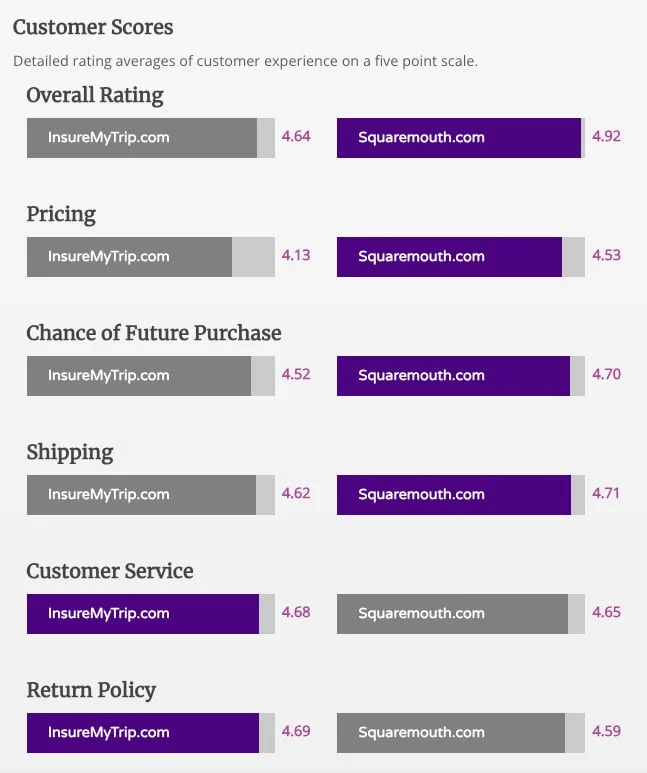
Both InsureMyTrip and Squaremouth have over 30k reviews on the 3rd party review site, ResellerRatings. Both companies have excellent overall scores above 4.5 stars.
While Squaremouth has a higher overall rating, InsureMyTrip is proud to rate higher in the specific categories of Customer Service, Reply Back Rate, and Resolution outreach.
(These ratings are based on data from user reviews and are accurate as of the time of publication. Be sure to check ResellerRatings.com for the current comparison between the two sites.)
While we don’t want travelers to run into any issues, we do want them to feel secure in knowing our Customer Care team is available for them six days a week. Our specialized Anytime Advocates® are in constant communication with the insurance providers and happy to help in the event you need to file a claim. This means you can rest assured that you will have our support before, during, and after your trip.
Accredited by the Better Business Bureau
InsureMyTrip is proud to be accredited by the Better Business Bureau (BBB) and has received an A+ rating.
Squaremouth is also listed on the BBB listings with an A+ rating.
We Won’t Sell You a Plan You Don’t Need
While some comparison sites return results for the plans that will make them the most money, the licensed agents at InsureMyTrip only provide recommendations that meet the customer’s needs. To put it another way, InsureMyTrip won’t sell you a plan you don’t need – even if the “best” plan for them is “no plan at all.”
Squaremouth features several of their own comprehensive plans that often appear first when customers search for a plan. On the other hand, InsureMyTrip only shows comprehensive travel plans from our trusted providers.
While it’s true that InsureMyTrip does offer its own IMT Travel Accident Plan, this plan is used as an add-on for travelers looking to supplement gaps in accidental death and dismemberment coverage. Additionally, we will not recommend this plan over other providers’ plans.
This “customer first” approach is not just some arbitrary tagline. Rather, it’s a philosophy that has been part of the InsureMyTrip mission since its founding in June 2000.
Disclaimer: The information contained in this article serves as a general overview of benefits and should only be used for informational purposes. Refer to your individual certificate of insurance for specific coverages, exclusions and benefits. Please contact one of our licensed agents for additional assistance if you have questions. Please note that InsureMyTrip is not affiliated, associated, authorized, endorsed by, or in any way officially connected with Squaremouth or their products. The information presented in this article is true and accurate as of the time of publication.
The way travelers communicate has changed over the years. Social media is an easy-to-use tool that can be quite powerful, particularly when discussing a user’s viewpoint or experience. Because of this, tracking the data around particular companies or brands is simple when using social media listening tools. Twitter is an extensive resource of customer opinions and satisfaction.
Using sentiment analysis, which uses artificial intelligence to detect the emotional tone of tweets, we identified which airlines received the most negative mentions.
In 2019, we monitored over 96,000 tweets mentioning the nine largest U.S. airlines over a two-week period. In 2021, we analyzed an additional 25,000 tweets to observe how the COVID-19 pandemic had affected rankings. For 2022 we revisited this topic and reviewed 3928 tweets to monitor the current U.S. Airline landscape and compare these results to previous observations.
For 2022 Allegiant Air was missed off the data as the tweets which were pulled out related to the Allegiant stadium, not the airline.
U.S. Airline Twitter Sentiment Analysis
Airline
% Positive
Southwest Airlines
70%
Allegiant Air
64%
Alaska Airlines
62%
Delta Air Lines
51%
JetBlue Airways
51%
United Airlines
51%
American Airlines
44%
Frontier Airlines
36%
Spirit Airlines
31%
Airline
% Negative
% Positive
Southwest Airlines
30%
70%
Allegiant Air
36%
64%
Alaska Airlines
38%
62%
Delta Air Lines
49%
51%
JetBlue Airways
50%
51%
United Airlines
50%
51%
American Airlines
56%
44%
Frontier Airlines
64%
36%
Spirit Airlines
69%
31%
Southwest Airlines came out on top with 69.9% of their mentions being positive, closely followed by Allegiant Air with 64.40%, Spirit Airlines worryingly received over 69% negative mentions.
We wanted to find out exactly what was causing these negative mentions for each airline. For our research we targeted stereotypical complaints put forth by customers including delays, cancellations, poor customer service, lost luggage, uncomfortable seats and bad food. This gave us an idea of what bad experiences could be expected by each airline and what each airline needs to consider a priority concern.
Airline
% Positive
% Change Positive From 2019
Spirit Airlines
21%
-10%
Frontier Airlines
24%
-13%
American Airlines
27%
-17%
United Airlines
32%
-19%
Alaska Airlines
43%
-19%
Delta Air Lines
30%
-21%
JetBlue Airways
25%
-25%
Southwest Airlines
32%
-38%
Allegiant Air
26%
-38%
Hawaiian Air
36%
–
Airline
% Negative
% Change Negative From 2019
% Positive
% Change Positive From 2019
Spirit Airlines
59%
-10%
21%
-10%
Frontier Airlines
59%
-5%
24%
-13%
American Airlines
53%
-3%
27%
-17%
United Airlines
42%
-7%
32%
-19%
Alaska Airlines
32%
-6%
43%
-19%
Delta Air Lines
45%
-4%
30%
-21%
JetBlue Airways
52%
3%
25%
-25%
Southwest Airlines
45%
15%
32%
-38%
Allegiant Air
53%
18%
26%
-38%
Hawaiian Air
34%
–
36%
–
Alaska Airlines had the highest positive rating with 42.76% of their mentions being positive in tone. However, the pandemic has taken a toll, as our 2019 calculation showed 62.1% of their Twitter mentions as positive.
It should be noted that, since the start of the pandemic, all airlines have had a significant reduction in the number of positive mentions and some a large increase in negative mentions.
Southwest Airlines, who came out on top in 2019 with 69.9% positive mentions, had just 32% of mentions as positive.
Spirit Airlines, who had previously received over 69% negative mentions, have managed to reduce their share of negative mentions to 58.55%. But this is still the second highest overall.
The most negatively tweeted airline in the pandemic was Frontier Airlines with 58.94% negative mentions.
We wanted to find out exactly what was causing these negative mentions for each airline. Our research targeted common complaints put forth by customers including delays, cancellations, poor customer service, lost luggage, uncomfortable seats and bad food. This gave us an idea of what negative experiences could be expected by each airline and what each airline may want to consider as a priority to address moving forward.
We also added common complaints specifically associated with flying during the COVID-19 pandemic including masks, COVID-19 testing requirements, social distancing and mandatory paperwork to fill out.
Airline
% Positive
% Change Positive From 2021
United Airlines
26%
-6%
Spirit Airlines
14%
-7%
American Airlines
19%
-8%
Frontier Airlines
13%
-11%
JetBlue Airways
14%
-11%
Delta Air Lines
17%
-13%
HawaiianAir
23%
-13%
Alaska Airlines
29%
-14%
Southwest Airlines
18%
-14%
Airline
% Negative
% Change Negative From 2021
% Positive
% Change Positive From 2021
United Airlines
37%
-5%
26%
-6%
Spirit Airlines
59%
0%
14%
-7%
American Airlines
59%
7%
19%
-8%
Frontier Airlines
61%
3%
13%
-11%
JetBlue Airways
52%
0%
14%
-11%
Delta Air Lines
52%
7%
17%
-13%
HawaiianAir
43%
9%
23%
-13%
Alaska Airlines
51%
20%
29%
-14%
Southwest Airlines
49%
4%
18%
-14%
Once again Alaska Airlines has the highest percentage of positive rating, with 29% of their mentions being positive in tone. However, this rating has decreased by 14% in comparison to 2021.
For context, we observed that all airlines have significantly decreased the number of positive mentions across the platform.
Southwest Airlines endured a 14% drop in positive mentions. Similarly, Hawaiian Airlines suffered a 13% decrease, falling from 35.6% to 23%.
United Airlines demonstrated the only reduction in negative mentions, improving their return by 5%. They currently hold the lowest number of negative mentions with 37%.
The most negatively tweeted airline during 2022 was Frontier Airlines with 61% negative mentions.
We set out to identify what caused these negative mentions for each airline. Our research targeted common complaints put forth by customers including delays, cancellations, poor customer service, and lost luggage. This provided us with an idea of what negative experiences may occur across the selection of airlines, as well as highlighting aspects airlines could reference for improvement in the future.
The Top Concerns While Flying By Airline
Airline
Delay
United Airlines
24%
JetBlue Airways
23%
Allegiant Air
21%
Delta Air Lines
19%
Frontier Airlines
19%
Spirit Airlines
17%
Alaska Airlines
16%
Soutwest Airlines
16%
American Airlines
14%
Airline
Delay
Cancel
Customer Service
Luggage
Money
Seats
Food
Soutwest Airlines
16%
11%
5%
2%
16%
16%
3%
Alaska Airlines
16%
8%
5%
3%
1%
2%
2%
Allegiant Air
21%
6%
7%
1%
3%
1%
1%
JetBlue Airways
23%
7%
4%
1%
2%
2%
1%
Delta Air Lines
19%
9%
6%
2%
1%
1%
1%
Frontier Airlines
19%
13%
9%
2%
2%
1%
1%
Spirit Airlines
17%
19%
7%
2%
4%
1%
1%
American Airlines
14%
10%
7%
2%
3%
3%
1%
United Airlines
24%
11%
7%
2%
2%
2%
0%
United Airlines had the highest proportion of negative tweets (23.58%) that related to delays, while 11.15% were about cancellations, a combined total of 34.73% for these two categories.
While every airline experiences delays and cancellations due to factors out of their control, it seems United Airlines and Spirit Airlines are particularly substandard in the way they handle customers in these situations.
Interestingly, Southwest Airlines (who received the least negative mentions overall) see their biggest complaint is about money, while the rest of the airlines have limited complaints about this. Furthermore, Southwest Airlines received the highest proportion of negative mentions for keywords regarding seating (15.7%), which may be due to their policy on not assigning seats.
To conclude, while we cannot infer that this means one airline has more issues than another, it certainly gives us an idea of what each airline struggles with the most.
By understanding what each airline struggles with we can manage our own expectations of each airline. If you are looking to prioritize customer service for example, it is logical to expect Frontier Airlines may struggle with providing quality customer service, but it is likely their seating is comfortable, and food is satisfactory. Knowing this prior to flying with Frontier will likely improve the overall experience as there is little to no expectation of quality customer care. Alternatively, if you are looking to experience high quality care it would be wise to avoid this airline entirely.
Overall if you are looking for a hassle-free experience, Southwest Airlines are the most likely to bring you this based on social media reaction. On the other hand, flying with Spirit Airlines may lead to a negative experience in some form.
*Data collected from Brand24
Airline
Delay
Spirit Airlines
12%
Frontier Airlines
10%
American Airlines
9%
Unitied Airlines
8%
JetBlue Airways
7%
Delta Air Lines
7%
Alaska Airlines
7%
Allegiant Air
4%
Southwest Airlines
3%
Hawaiian Air
2%
Airline
Delay
Cancel
Customer Service
Luggage
COVID-19 Testing
Masks
Refunds
Unitied Airlines
8%
10%
5%
1%
0%
0%
3%
American Airlines
9%
10%
6%
1%
0%
1%
3%
Alaska Airlines
7%
7%
5%
1%
0%
1%
3%
Allegiant Air
4%
6%
5%
3%
0%
1%
2%
Delta Air Lines
7%
6%
8%
1%
0%
0%
0%
Frontier Airlines
10%
7%
4%
1%
0%
0%
0%
Southwest Airlines
3%
2%
4%
0%
0%
1%
0%
JetBlue Airways
7%
5%
1%
1%
0%
3%
0%
Hawaiian Air
2%
1%
2%
0%
0%
1%
0%
Spirit Airlines
12%
9%
5%
1%
1%
0%
0%
Spirit Airlines had the highest percentage of negative tweets (12.05%) related to delays. However, this is a reduction from 2019, where they previously had 16.69% of their negative tweets about delays.
Interestingly, complaints relating to COVID-19 specifically were very low across all airlines. This indicates that, overall, all airlines seem to be upholding their new protocols relatively well. JetBlue had the highest share of complaints around Personal Protective Equipment (PPE) and mask protocols (3.26%). However, these still represent a significantly low number of complaints overall. The majority of complaints for JetBlue were associated with delays (6.83%) and cancellations (5.43%).
Airline
Delay
Frontier Airlines
14%
American Airlines
11%
JetBlue Airways
11%
Southwest Airlines
11%
Spirit Airlines
10%
Delta Air Lines
6%
Alaska Airlines
5%
United Airlines
5%
HawaiianAir
3%
Airline
Delay
Cancel
Customer Service
Luggage
Money
Flight Attendant
Southwest Airlines
11%
3%
4%
7%
8%
6%
United Airlines
5%
5%
2%
1%
5%
6%
Alaska Airlines
5%
5%
7%
5%
3%
5%
JetBlue Airways
11%
11%
6%
1%
7%
5%
American Airlines
11%
4%
7%
2%
8%
4%
Delta Air Lines
6%
5%
3%
6%
10%
3%
Frontier Airlines
14%
16%
6%
1%
20%
2%
Spirit Airlines
10%
5%
9%
5%
14%
2%
HawaiianAir
3%
7%
3%
4%
5%
1%
Frontier Airlines represented the highest percentage of negative tweets (14%) regarding delays. This is a vast increase in comparison to their 2021 data (9.53%).
Southwest Airlines received a substantial 7% of their negative tweets regarding luggage. In 2021 they only received 0.05%, the lowest of all Airlines observed.
Spirit Airlines notably increased to 9% in negative tweets concerning their customer service, demonstrating a 4.2% growth from 2021.
The Top Concerns While Flying Overall
Concern
Percentage of Tweets
Cancelations
7%
Delays
7%
Customer Service
5%
Refunds
3%
General COVID-19 Concerns
1%
Masks
1%
Luggage
1%
Hidden Charges/Costs
1%
Tests
0%
Cleanliness
0%
Covid-19 Forms
0%
Social Distancing
0%
Across all airlines, cancellations and delays remain to be the most popular complaints in the COVID-19 era. Beyond general COVID-19 related concerns (any complaint that included the word ‘covid’ within it), masks were the biggest complaint related to the coronavirus.
Overall, however, COVID-19 concerns were significantly low, indicating that travelers had confidence in their safety when flying either domestically or internationally.
To conclude, while we cannot use this data to presume that one airline has more shortcomings than another, it certainly gives us an idea of possible opportunities for improvement. Understanding what each airline struggles with may help travelers manage their expectations of the experience each airline provides.
A key takeaway from our research is that while all airlines may be getting an increase in criticism across social media overall, the number of complaints related to COVID-19 protocols are actually very low.
For travelers looking for a hassle-free experience, Alaska Airlines may be the most likely to provide this, based solely on social media temperament at the time of publication. Other high performing airlines include Hawaiian Airlines and 2019’s winner Southwest Airlines. Travelers may also want to consider the high number of complaints regarding experiences with Frontier and Spirit Airlines as there may be some room for improvement with these services.
*Data collected from Brand24
Concern
Percentage of Tweets
Money
5%
Delay
4%
Cancel
3%
Customer service
3%
Luggage
2%
Flight Attendant
1%
Money-related complaints represent 5% of all negative tweets across airlines, rising above all. Delays and cancellations remain among the most mentioned in negative tones, however, both have improved substantially.
To conclude, while we cannot use this data to presume that one airline has more shortcomings than another, it certainly gives us an idea of possible opportunities for improvement. Understanding where each airline may struggle can help travelers manage their expectations of the experience of each airline.
A key takeaway from our research is that while negative feedback on social media remains consistent across all airlines, the number of complaints has decreased significantly in comparison to 2021.
For travelers seeking a smooth experience, Hawaiian Air appears to have the lowest number of complaints across social media at the time of publication. 2021 winner Alaska Airlines remains an honorable mention.
Alternatively, travelers should acknowledge the high number of complaints recorded by Frontier Airlines and Spirit Airlines as there may be room for improvement within their services based on customer feedback.
“Bermuda, Bahama, come on pretty mama…” It’s no surprise the 1988 Beach Boys hit “Kokomo” features the Bahamas so prominently. Even today, the island getaway remains one of the most popular vacation destinations among travelers.
In light of recent hurricane activity in the area and COVID-19 pandemic, our customers are increasingly asking if travel insurance is required for trips to the Bahamas. Recently, the country removed the travel health insurance requirement for incoming visitors. While insurance is no longer mandatory for travelers, we highly recommend purchasing travel insurance coverage for health-related expenses, as well as travel delays, baggage loss, and other travel mishaps.
Concerns about illness, injuries, and medical issues have historically been the top reasons those traveling to the Bahamas ask about insurance. However, the destruction caused by Hurricane Dorian has changed the way people are thinking about coverage for the islands. Weather is now the number one concern driving Bahamas trip insurance inquiries. Unforeseen weather events can wreak havoc on travel plans by causing delays, cancellations, and even total destruction of your accommodations in some cases. Choosing an insurance plan that will cover these types of events is your best defense.
As mentioned above, many travelers to the Bahamas buy coverage to supplement or replace their domestic health insurance while they’re away. Most domestic health insurance providers do not provide coverage while you are out of the country. For this reason, those taking a trip to the Bahamas frequently purchase travel medical plans. This way, they can stay protected against hefty out-of-pocket costs as a result of unforeseen illnesses or injuries.
While healthcare and weather concerns are the main reasons travelers purchase trip insurance for the Bahamas, there are additional reasons worth considering. For example, the Bahamas is a popular destination among cruisers, so you might consider choosing a plan that incorporates cruise coverage if you plan to set sail. Other travelers may be flying internationally to reach the islands. In these cases, flight insurance can help travelers with unexpected issues, including delays, interruptions, and missed connections.
One of the most common questions we get from customers planning a visit to the Bahamas is “how much travel insurance will cost?” The cost of a Bahamas trip insurance plan varies due to several factors. First, the number of travelers in the group may affect the rate. In general, policies that cover more than one traveler have an increased cost. Second, traveler ages can play a role in determining pricing, as older travelers typically carry more risk as a result of medical concerns. This increased risk can translate to a higher cost, especially if one or more travelers in the group have any pre-existing conditions. Another important factor is the duration of your trip. Traveling for a longer period of time usually means there are more opportunities for travel hiccups. So, a plan that covers a week-long trip or vacation will be considerably cheaper than a plan that covers long-term travel. One of the most significant factors for determining the cost of travel insurance is the kind of coverage the plan offers. Typically, the price of a plan will increase for each coverage it includes.
Do I Need a Passport for the Bahamas?
Passports are required for nearly all travelers entering the Bahamas. In rare cases, passports are not required, and other documents can be substituted, but travelers are highly encouraged to secure a valid passport when visiting the Bahamas.
Although it is best practice to bring valid passports for every traveler when visiting the Bahamas, there are a few exceptions to the requirements. For example, if you are a U.S. citizen traveling to the island nation on a closed-loop cruise, meaning the cruise starts and ends at the same U.S. port, you may be able to use a driver’s license and birth certificate in lieu of a passport. Additionally, kids under the age of 16 may use a birth certificate, certificate of citizenship, or naturalization certificate, but only if they will be traveling to and from the Bahamas by sea. These exceptions will depend on the specific requirements of the cruise line. Be sure to check with your cruise company for the most accurate information. No matter which cruise company you choose, children and adults are both required to have a valid passport if they will be arriving to or leaving the country by air.
We strongly recommend securing a valid passport because, without one, you will not be able to fly back if a family or medical emergency requires you to leave unexpectedly. This is also true if you miss the boat at a particular port and need to fly to the next destination to reboard the cruise ship. For these reasons, it’s best practice to maintain valid passports for everyone in your travel party no matter your citizenship.
Do I Need a Visa for the Bahamas?
Tourist visas are not required for U.S. and Canadian citizens traveling to the Bahamas if the trip duration is less than 90 days. Business travelers and tourists who intend to stay longer than 90 days are advised to contact the closest Bahamas embassy or consulate to apply for a visa.
Non-citizens residing in the U.S. are not required to get a visa if the trip length is less than 30 days, but they will need to bring their Alien Registration Card (Green Card) and passport for entry. Non-citizen, permanent residents of Canada are not required to get a visa if the trip will last less than 90 days, but will need to travel with their Permanent Resident Card and valid passport from their country of origin.
Travel Tips & Safety for the Bahamas
Money & Currency Exchange
The Bahamian dollar (BSD) is the official currency of the Bahamas and exchanges at a 1:1 rate with the United States dollar (USD). Similarly, banknotes and coins are issued in many of the same denominations as USD, including $1, $2, $5, $10, $20, $50, and $100 bills as well as 1, 5, 25, and 50-cent pieces. There are also $1 and $20 Bahamian coins.
While the Bahamas issues its own paper notes and coins, U.S. dollars are also accepted at many restaurants, hotels, and stores. This is especially true in tourist hotspots, like cruise ports and resort destinations. There is no restriction on the amount of foreign currency that can be brought into the Bahamas, so bringing some cash with you is a great option since you’ll avoid exchange fees and have money for tipping. However, it’s a good idea to bring some other forms of payments too. This way, you can mitigate the risk of loss and theft.
Credit and debit cards offer another convenient way for travelers to access funds while visiting the Bahamas, but there are some considerations to make before you go. First, you’ll want to ask the issuing bank if your card’s PIN will work in the Bahamas, especially in the Out Islands. Some cards require four-digit PINs rather than six-digit PINs for overseas withdrawals. Similarly, these locations often require chipped cards to help thwart fraudulent activity. Additionally, you should check with your bank about any fees that may be imposed when making purchases or withdrawing money abroad. Fees for international transactions can really add up depending on how they are assessed. In some cases, your issuing bank will charge a fee on top of the fee charged by the bank who owns the ATM you’re using.
You should find out how accessible ATMs are in the areas you’ll be traveling to. For example, Paradise Island and New Providence Island have plenty of ATMs, but they can be harder to find on Grand Bahama Island, and there are very few ATMs located in the Out Islands. You should plan to bring some extra cash if you plan to travel to these more remote islands. Lastly, make sure to bring more than one card and that they are issued by different banks so you’ll have a backup plan in case one account is frozen.
Transportation
Like many island nations, the Bahamas is accessed by air or sea, but there are several options for getting around the islands once you’ve arrived. Transportation options include taxis, rental cars, and buses, as well as charter boats and planes. As a general rule, highly populated areas offer more modes of transportation.
Taxis
By far, the most popular mode of transportation in the Bahamas is the taxi. We encourage tourists to use only official taxis, which are easily identified by their colorful yellow license plates. Taxis are often found near hotels and airports for easy accessibility, but you can also call for a ride when you need to. In general, taxis are cash only so plan accordingly. Meter rates can vary somewhat but are regulated by law. Sometimes surcharges apply if there are more than two passengers or extra luggage.
Travel by Car
Renting a car can be a great option for those interested in taking the “road less traveled,” but keep in mind that UK driving rules apply in the Bahamas. This means you’ll need to drive on the left side of the road. You’ll also want to watch for roundabouts, which can be a bit startling for unprepared drivers. It’s a good idea to take a look at the local laws regarding the road before renting, especially if you’ll have small children who require car seats. For even more peace of mind, consider rental car insurance in case anything happens. Even if you don’t plan to rent a car, pedestrians should keep the traffic patterns in mind and look both ways before crossing the street.
Buses
Public transportation buses, referred to by locals as “jitneys,” are available on most of the major islands. This includes Paradise Island, New Providence Island, and Grand Bahama Island. The bus schedule typically runs from around 7:00 a.m. to 7:00 p.m. Jitney rates vary based on the route. Riders should note that exact change is usually required. Most jitney stops are clearly marked, so it’s easy to board in any of the service areas.
Boats & Charter Planes
If you’re looking to explore the Bahamian coastline and Out Islands, you’ll likely need to charter a boat. There are plenty of options and rates will vary based on boat size, number of passengers, and the route. Plane and helicopter tours are also available, although these options tend to be more expensive than boats. However you plan to tour the islands, the breathtaking views are sure to make for some fantastic vacation memories.
Culture
Like many nations in the Caribbean, the Bahamas has a laid-back culture that is both welcoming and hospitable. Bahamians are often described by tourists as easy-going, which is part of the reason the country remains a top travel destination. The population is diverse and is primarily comprised of descendants of indigenous people and British settlers, although the slow-paced “island life” has drawn transplants from all around the world in more recent years.
The nation’s proximity to the United States explains the many western values found throughout the culture. For example, Bahamians are deeply religious and primarily Christian, but the country’s constitution guarantees the freedom to celebrate any religion. Additionally, sports, art, music, and dance drive much of the country’s traditions and culture.
Speaking the Language
Another reason the Bahamas remains a popular destination among western tourists is the fact that the official language is English. This can make travel to the region much easier than some other destinations. Travelers shouldn’t expect typical American or British English, though. Instead, Bahamians have their own flavor of English. In fact, many people speak an English-based creole language referred to as “Bahamian dialect” sometimes called “Bahamianese” or simply “dialect.” The extent to which locals speak dialect is usually based on how the areas were settled and the subsequent populations living in those regions. It’s a good idea to brush up on some of the differences in pronunciation as well as colloquial terms that come up frequently. Overall, western travelers can expect that with some sharp listening skills and a little preparation, communication will not be a challenge.
Crime Risk & Traveler Safety
As is true for traveling to any destination, visitors to the Bahamas should exercise caution and employ general safety tips to avoid problems with theft, scams, and violence. Most travelers do not experience any issues when traveling in and around the Bahamas, but it’s a good idea to review any travel advisories for the areas you intend to visit before you go.
In general, you should do your best to avoid looking like a tourist, don’t answer your hotel room door unless you know who it is, and avoid carrying large amounts of cash or valuables on your person. In the unlikely event that you are targeted for theft, do not physically resist as this could make matters worse. If you have any doubts, consider a travel protection plan to recoup losses due to theft.
Foul weather is much more likely to affect your trip than crime, which was demonstrated recently by Hurricane Dorian and the damage the storm caused. The Bahamas lie in an area known as “Hurricane Alley,” so if you plan to travel to the country between the beginning of June and the end of November you should be aware that tropical storms and hurricane activity is much more likely. Make sure to plan ahead and keep an eye on weather patterns in the days leading up to your trip. This way you can make arrangements if the weather disrupts your plans.
Popular Destinations & Tourist Attractions in the Bahamas
The topography of the Bahamas is similar to many islands in the region in that the land is primarily low and flat. Even the country’s peak elevation is only about 200 feet high at Mt. Alvernia on Cat Island. As a result, tourists tend to gravitate toward the low-lying coastal areas and immaculate beaches. That said, the terrain also features lakes and mangrove swamps, which are home to unique wildlife and flora. Whether you plan to stay at a resort, explore the cities, or hang at the beach with the famous swimming pigs, you’re sure to find some great locations to do so. Every itinerary is different, but we’ve put together a list of popular tourist attractions and destinations so you can get started planning your perfect Bahamas trip.
Top 10 Travel Destinations in the Bahamas
Andros Island
Grand Bahama
Long Island
Bimini
Harbour Island & Eleuthera
Nassau
The Abacos
Atlantis Resort (Paradise Island)
Cat Island
Exuma Cays Land & Sea Park
U.S. / Bahamas Embassy and Consulate Locations
U.S. Embassy in The Bahamas
U.S. Embassy Nassau
42 Queen St.
Nassau, The Bahamas
Phone: 242.322.1181
Bahamas Embassy and Consulate in USA
Washington DC – Embassy of The Bahamas
2220 Massachusetts Ave, NW
Washington DC 20008 United States
Phone: 1.202.319.2660, 1.202.319.2667
Miami, Florida – Consulate General of The Bahamas
100 N. Biscayne Blvd, #900
Miami, FL 33132 United States
Phone: 1.305.373.6295
Atlanta, Georgia – Consulate General of The Bahamas
2970 Clairmont Road NE, Suite 290
Atlanta, GA 30329 United States
Phone: 1.404.214.0492
New York, New York – Consulate General of The Bahamas
231 East 46th Street
New York, NY 10017 United States
Phone: 1.212.421.6420
Disclaimer: The information contained in this article serves as a general overview of benefits and should only be used for informational purposes. Refer to your individual certificate of insurance for specific coverages, exclusions and benefits. When in doubt, please contact one of our licensed agents for additional assistance.